Monday, October 30, 2006
Senses and Stories

Muy Interesante
This is a passage from a speech by Dudley Malone during the Scopes trial, and he was speaking for the prosecution. Just for those who don't know the Scopes trial was a product of the conflicting cultural cross current of the era. It was trial for a teacher from Dayton who was accused of teaching evolution, which was against the law at that time, and was put on trial to see if he should be charged with the $100 fine that was the punishment of doing such a thing. However the trial turned far more into as Roger Baldwin put it "the good book against Darwin, bigotry against science, or as popularly put, god against monkeys." It became a defining point in the history of Americans morals and beliefs. Even though Malone was on the prosecution he felt the genesis and evolution were not in conflict. So here is his closing statement with a tribute to the power of truth:
"Truth always wins and we are not afraid of it. The truth is no coward. The truth does not need the law. The truth does not need the forces of government. The truth does not need Mr. Bryan (prosecuter) The truth is imperishable, eternal, and immortal and needs no human agency to support it. We are ready to tell the truth as we understand it and we do not fear all truth that they can present as facts. We are ready. We are ready. We feel we stand with progress. We feel that we stand with science. We feel that we stand with intelligence. We feel that we stand with fundemental freedom in America. We are not afraid. Where is fear? We meet it. Where is fear? We defy it..."
Thoughts ideas? anyone
Sunday, October 29, 2006
Dark Matter
I guess my overall question revolves around when and how a concept like dark matter can become knowledge. Currently, we are not able to perceive dark matter with our senses. Some scientists have made theories about it because it seems to explain some occurrences in space, but do they know that dark matter exists? What do they need as evidence to claim that it does exist? Do they need more examples like the bullet cluster? If so, how many more? Also, when will the average person be able to claim it as knowledge? Most people can not understand these theories because they are so complex. Are the scientists a reliable authority for the general population?
Here's a link to an article on some of the general ideas and the bullet cluster if you missed the lecture or if you're just looking for an interesting read:
http://home.slac.stanford.edu/pressreleases/2006/20060821.htm
my two left feet
Sunday, October 22, 2006
"When Not Seeing Is Believing"
I found it really interesting when the article mentioned the impossibility of proclaiming truth with a capital T when it comes to faith. There is always a sense of uncertainty that humans will never grasp. At the heart of religion is humanness marked by imperfection and uncertainty that was even seen in Jesus.
So, as humans strive towards an absolute truth, it is real doubt that teaches people to believe. Faith does not come from sense perception. So I don’t think it can be close to absolute
This is why I see certainty of faith as a paradox. Faith incorporates doubt, so religion cannot be used as a certainty in any kind of political decision. Political divisions then arise so strongly.
What does everyone think about this? It’s a really good article that gives a much better account of what I just said, so you should really read it.
-anya
Saturday, October 21, 2006
How can faith blind/impair our perception?
This question i thought might be good for what we're learning in class. People should be thinking about it.
Thursday, October 19, 2006
Art, Literature, and Everything in Between
Mait
Wednesday, October 18, 2006
The Genius of a Child... repost
Marla Olmstead, a six-year old who sold her first painting for $250 when she was 2 years old and is now considered an artistic prodigy. Check out her work by following the link above. She has been featured by...
LA Weekly
The New York Times
60 minutes
The Today Show
BBC News
and many, many others...
Just thought it might add to your discussion as to what defines genius and the subjective nature of artistic "knowledge". What do you think?
What is art???
Language
What constitutes a language? Is it possible to have language other than the spoken word? i.e. Can you consider mathematics as a language? What about the languages of music and art? Do you think that it is possible to have a language that is not spoken? What are the boundaries and/or limitations and benefits of having a language that is not spoken? Are there any similarities/dissimilarities between the languages of math, music, and art? To what extent would we be effective at communicating ideas in these languages if we cannot speak it? How is this different from perception?
This is kind of a broad topic, so you don't have to answer all the questions I posted...
Monday, October 16, 2006
The Elusive Truth
Can one culture or area of the world or even one era, for that matter, claim to have more knowledge than another culture/area/era because more of their beliefs are properly justified???
For example, while one culture may only be able to base their beliefs off of instinct or what was believed in the past, does that make those beliefs less justifiable than a culture that can justify theirs with techonology, scientific investigation, etc., maybe even in addition to instinct and the like?
Does this tie into personal vs. descriptive justifications? does that descriptive knowledge have to count for the whole world, for all time (is that what Truth is??) or just for the era, the locality?
Does that mean we are moving any closer to the Truth as we go along and gather more means of proper justification?
Does your head hurt yet?
Sunday, October 15, 2006
Truth In America
"According to the Poynter Institute's Dr. Roy Peter Clark, 'The truth is being distorted from all corners, and Americans don't see it, or if they do, too many don't seem to care.' Here are seven things Dr. Clark says you can do to recognize manipulation in government, media, business and advertising:
1. Find three political bloggers who represent the right, the left and the middle. Consult them to help you sort through political issues and media messages.
2. Look for role models of candor and accountability, people in public life who have proven to be reliable over time. Look especially for folks within a movement or political party who have the courage to speak against the interests of their own party.
3. Prefer people who want to have a vigorous conversation to those who want to shout at each other.
4. Do not be seduced into thinking that every hot-button issue requires you to be on one side or the other. There may be a middle ground. Don't be afraid to be puzzled or uncertain about an issue. It's okay to be working to make up your mind.
5. Get up off the couch. Join a club. Volunteer. Sing in the choir. One way not to be fooled by political or media manipulation is to learn from direct experience, from reality and not reality TV.
6. In an age of celebrity culture, try to pay more attention to people for what they do than for who they are.
7. Be a skeptic, but not a cynic. A skeptic doubts knowledge. A cynic doubts moral goodness. The cynic says, "All politicians are liars," or "all journalists have a secret bias." The skeptic says, "That doesn't sound right to me. Show me the evidence."
Good, Interesting Advice no matter which side of the fence you are on...
Wednesday, October 11, 2006
Perceiving the future
i.e. Let's say I predict that an asteroid will crash into Earth and destroy Antarctica exactly 1 week from now. Can I claim it as knowledge right now or would I have to wait 1 week and then confirm my prediction? Let's say that I perceived this through the stars, and it does turn out to be true; is it a valid way of perception or did I just make a wild guess and got it right?
Tuesday, October 10, 2006
Egypt
For me, i say Aliens. Stargate was proof enough for me, but what do you think, and why?
Monday, October 09, 2006
The love-pancake theory
Alright, now that I've got that out of my system, let's move on. For my first post, I would like to present you all with a game. This game, for simplicities sake, will be called "The Love-Pancake theory". Below are three rules. These rules are the only truths we have, these are the only things we know. However, you may add new rules during the course of the game. You may add a new rule by proving it to be true, and by having three more people agree than disagree with this rule.
1) Love is blind
2) Love= ♥
3) Love will keep us together.
Thus, given the rules above, your task is this: Diiscuss wether or not the picture below is love. Remember: If you wish to disproove this as love, you must either prove it is not through the rules above, or create a new rule that proves it is not. No new rule can directly contradict another, i.e there cannot be a rule stating "Love can see". However, there can be a rule that shows the picture is not love, i.e "Love is a battlefield".
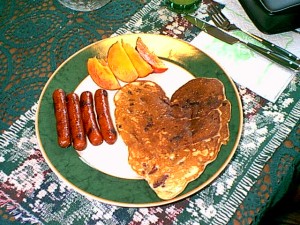
I've either confused you all and no one will post on this, or this will work out to my own devious plan and we will have people arguing about wether or not love is a heart-shaped pancake.
Crash
Crash
How does this movie relate to Perception and Ethics? (or TOK in general)
What questions does Haggis (director) wish his audience to ask of themselves?
What message did you get from the movie?
What is your overall personal reaction?
Answer any, all, or none.
Try to go beyond...
"Racism is bad" and "Don't judge a book by its cover".
Wednesday, October 04, 2006
History vs. Science
Tuesday, October 03, 2006
Emotion and Knowledge
By the definitions given us by our TOK language, a moral/ethical belief can qualify as an emotional claim to Knowledge. Knowledge must be a PJTB, as defined by TOK. Yet moral/ethical issues are completely and entirely relative, and cannot be proven true in any sense of the word. So, the way I see it, TOK is wrong here - Knowledge claims that use ethical/moral/emotional beliefs as their basis cannot possibly be True.
Am I interpreting this wrong, or does what I just said hold some validity?
Sunday, October 01, 2006
Well, was I right?
TED
"There is a story of the new recruit at an engineering company, fresh out of college, who was given a circuit to analyze on his first day on the job. He worked on it for most of the day and then brought his solution to the manager who had assigned the task that morning. The recruit placed his solution on the desk and waited eagerly for a response. The manager looked at the paper and then filed it. The recruit lingered for awhile and then said, 'Well was I right?'
The manager was shocked. He asked, 'Why would I pay you to find answers that I already know?'”
Just thought you might enjoy this...
I'm sure many of you fall into a similar trap.
The question is...
Why, as students, is verification so often needed when searching for answers to the questions that you are challenged with?
Saturday, September 30, 2006
The Internet and Global Knowledge
How might this affect our perception of history?
Tuesday, September 26, 2006
Perception maybe?

Hello. This is Vvinni. If you understand this, put three "E"'s at the end of your post.
Hello, it's Vvinni. Since we're talking about perception, and how people see things differently, and patterns, and so forth. I thought it would be neat to do this. Above is a message, written in a font I made (The image). Your mission is to tell me what this message says, and tell me how you know. Please be as analytical or as faith-based as you want. And please, respond this time.
Well, until next time. I'm Vvinni/Vynni/Vigni/Vinni, and good night.
Can you read me? Can you read me? Can you read me? ffrrttccvvaazz
Sunday, September 24, 2006
Equals
Saturday, September 23, 2006
Synesthesia
Check out this site, it gives good information about different kinds of synethesia: http://home.comcast.net/~sean.day/html/types.htm
Thursday, September 21, 2006
Lies, all lies
On a related note, can our percieved truths act like a spectrum, where something appears so inconceivable that we think that therefore it's true?
Wednesday, September 20, 2006
science and perception
In Memoriam: Language
And this is a segue.
The tail end of "Canada has a battleship?!" raised an interesting question. Since language is the metaphorical Soup of the Day at the literal Family Feedbag that is TOK, I'll reiterate this question here:
The English Language, can we kill it? How? Are we doing so now? Did anyone notice the comma I spliced three sentences ago?
This is a closing,
-Scummy
Tuesday, September 19, 2006
One Guarantee
I'm not sure how incredibly relevant this is to TOK, except for the fact that it was question I pestered several of my TOK classmates with. They suggested I post it here and see if I could get some responses. So, I pose to you the following hypothetical question:
If you were able to guarantee one thing in your life between now and the age 30, but that guarantee would be guaranteed for only a moment, after which your life would proceed on it's natural course, what would the guarantee be? As this is a rather convoluted question, I'll offer several examples:
If you chose to be happily married to Brad Pitt, then you would be able to guarantee that for a moment between now and when you were 30, you would be happily married to Brad. After that moment, you could continue to be happily married, but you would now have to maintain the relationship, it would no longer be "magically guaranteed." In fact, the next day, assuming you committed a terrible enough offence, you could be divorced, or you could party down on your 50th anniversary.
If you chose to be a pro basketball player, then you would be guaranteed to be playing in the NBA for at least one moment before you were 30. However, after that moment, you might tear an ACL or get cut if you’re no longer up to snuff. On the same line of thought though, you could be the next Michael Jordan, after the one guaranteed moment, the course of your life is once more wholly dictated by your own actions.
What would your guarantee be? Keep in mind answers that are more plausible are generally yield a more interesting insight on human nature.
Monday, September 18, 2006
God exists
Can anyone know that god exists as descriptive knowledge, or will it always be confined as aquaintence knowledge?
Would something as sublime as a god figure coming down from heaven make this claim descriptive? Or, what about Jesus? Was this knowledge descriptive during the time of Jesus, at least among believers?
Sunday, September 17, 2006
Knowing and Politics
In a September 8th story on NPR's "All Things Considered," it was reported that, "Dozens of Syrian migrant farm workers were killed in one village [by Israeli air strikes], and
This raises an important question in the knowledge created by this occurrence. As we do not know the true reasoning for the air strikes, and probably will not be able to know the reasoning behind the attacks for quite some time (until information currently kept in classified Israeli documents are released), can we form a knowledge claim about the morality of the subject? Is it ever possible to make an accurate knowledge claim when such conditions exist? As most of us have grown up and been educated in the
Neither the administration, nor either of the legislative branches made any effort early in the conflict to intervene and stop the violence, nor did they condemn the aforementioned attacks on civilian establishments. Assuming that the events did indeed occur; could one make an accurate knowledge claim that we, as the electors of the
Perception Problem
Discuss...
Meaning?
Does this have any meaning? Is This post constructive? Is anything I say constructive? Discuss.
Thinking without Language?
-Rachael Reeves
Saturday, September 16, 2006
What is the true nature of color?
http://www.iep.utm.edu/c/color.htm
Visual Perception
Thursday, September 14, 2006
Solipsism
Wednesday, September 13, 2006
Language without verbs
Propoganda, is it really that bad?
Tuesday, September 12, 2006
Is it possible to have ESP?
Is it possible to know or think about something before it happens, and not really believe anything yet about what is to come, but still have ideas in your head about the outcomes that you think are most possible, and then what if it happens? Do you have ESP or is this knowledge just out of your intuition? Is it knowledge? what is it?!
For instance... Before today, i was thinking about the musical auditions, which, I tried out. I was thinking, negatively, that i wouldn't make it in, even though some people told me i did great. But, as it turned out, i didn't make it into the musical.
Thus we have the question: Can preconceived thoughts about an outcome influence an outcome, if indirectly?
"I don't know much." -Socrates
"The only thing that I know is that I know nothing." -Socrates
Will you openly admit that the only piece of knowledge that we can hold that is an absolute truth is that we don't know much? Or we don't really know anything to begin with.
But then perhaps we get more? Or not?
Side note: (Ignore this side note unless you're looking for a good bit of entertainment at my expense).
Did my question make sense? sorry i'm tired and my right eye was pushed into my head by like a foot or so when my dad tried to touch my forehead and give me acne when he was being evil but missed and hit my eye instead. owch. (I was exaggerating a bit about my eye being pushed in by a foot in distance...because that would mean my eye came out the back of my head a while back). (hahaha lol). (ok i'll be quiet now).
Do humans possess truth? How much? How do we know? Are these good enough questions dangit?
Monday, September 11, 2006
Canada has a battleship?!
Really you may be wondering "what is her point?!" Or maybe you just didn't know that Canada DOES go to war? well my point is to question our understanding of modern countries around us. We need to ask ourselves, 'am i really paying enough attention to the news? am i an educated being?'
And really more in depth, if you dont feel like reading the article or are for some reason unable to, why do we have so much fun joking about Canada, eh? How come we don't know anything about the countries that are directly above and below us, more specifically, how can we joke about it if we know almost zip about it? its as if we dont take an interest. Because nothing's interesting!
Links to learn about Canada:
http://en.wikipedia.org/wiki/Canadian_Forces
http://www.satirewire.com/news/feb02/warship.shtml
http://www.forces.gc.ca/site/focus/canada-us/backgrounder_e.asp
The second link is for entertainment and to get you interested in the issue. i highly recommend reading the second link, its my favorite.
Another intriguing question to ask ourselves is 'what are satirists up to these days, and how are our actions affecting what they choose to satirize?'
Hope this gets you into satire! If not, I hope that it makes you think about Canada so that it doesnt disappear from the face of the Earth.
Meredith Salimbeni
Simulated Reality
So I ask of you a few things.
First. Read the page, it isn't very long and it will help.
Second. Answer wheather or not you think we are in a simulated reality.
Thirdly. Should we ever try to create a simulated reality.
Fourth, and perhaps most interesting and applicable. What would happen if you grew up in a simulated reality and were taken out of it?
Sunday, September 10, 2006
Can you think?
The question is: Can you think without language?
Thursday, September 07, 2006
Santa Clause
Does Santa Clause exist? How do you know?
Wednesday, September 06, 2006
Girl Imprisoned for 8 Years in Underground cell
Here's the Link.
Try out a ToK prompt!
Now that you've learned some of the vocabulary and have engaged in some excellent discussions about relevant issues, I'd like to challenge you to tackle the following ToK prompt from a former prescribed title list.
As you think about responding, consider: What is the question really asking? Are there more than one way to answer it (think claims and counter-claims)? What real-life examples can you use to illustrate your claims and counter-claims?
Shoot for a paragraph or two. After you're done, you might want to give a quick reflection on how this went for you. Was it easy? Difficult?
If you don't want to try it yourself, you might want to read some of your fellow students' responses and give them some feedback.
Question: What is the difference between 'it is certain' and 'I am certain,' and is passionate conviction ever enough to say you really know anything?
Have fun! Mrs. King
Monday, September 04, 2006
Pile of chocolate ice cream
So, lets to say that I really want to be a pile of chocolate ice cream. I tell myself that I am a pile of chocolate ice cream day after day, until soon I believe it, and I see myself as a pile of chocolate ice cream. Thus, am I actually a pile of chocolate ice cream? Or, because no one else will see me as a pile of chocolate ice cream, am I not a pile of chocolate ice cream? Is this worthwhile to talk about when thousands of people are dying in Iraq? Please to answer.
Pink Text!
The Genius of a Child
LA Weekly
The New York Times
60 minutes
The Today Show
BBC News
and many, many others...
Just thought it might add to your discussion as to what defines genius and the subjective nature of artistic "knowledge". What do you think?
Sunday, September 03, 2006
Baby Geniuses
Knowledge, Understanding, and Jazz
I said: "Oh, it's organized".
Quoth my father (slightly sarcasticaly) "You mean to say that there are things in jazz that are more complex and sophisticated than I might think?"
"Well, yes" I had to say
Then my mother said "But if we don't understand it then how can we believe you?"
Thus, my question:
Can you really believe, and thus know, something if you don't understand it?
For instance: If your best friend came up to you and said "Pablo ate an entire swinger" And you had no idea who Pablo was or what a swinger was, could you really believe or know that "Pablo ate an enitre swinger".